-
Our Mission
Everything we do starts with our Mission: to enable our customers to make the world healthier, cleaner and safer.
Read More -
Our Mission
Everything we do starts with our Mission: to enable our customers to make the world healthier, cleaner and safer.
Read More -
Our Mission
Everything we do starts with our Mission: to enable our customers to make the world healthier, cleaner and safer.
Read More-
- Tackling Crime by Trading Punishment for Treatment
- Customer Stories
- Removing the word serial with rapid DNA
- Turning the tap on without fear
- Second shot at life
- Mission in a Minute
- Creating Empowerment Opportunities in the Veterinary Sciences
- Building hope and affordable homes in Michigan
- Preeclampsia
- This Girl is On Fire
- Counting on You
- Allergy Diagnostic Tests Help Ambitious Tennis Player Get Back in the Game
- Tackling Crime by Trading Punishment for Treatment
- POWER Act Aims to Fund Science-based Technology to Address Opioid Crisis
- Supporting connections that lead to life-saving medical care
- Microbiologist's near-fatal battle with sepsis highlights urgent need for awareness and better treatment protocols
- An Icelandic volcano expedition exploring newly formed lava tubes uncovers insights into Earth's origins.
- How Thermo Fisher Scientific colleagues partner with Ronald McDonald House to support families of pediatric patients
- This is a test
- This is another test for a tutorial!
- Text and Image Demo
- Survivor of domestic violence finds new hope with prosthetic hand
- Thermo Fisher colleagues’ passion to advance HIV clinical trials help make lifesaving therapies a reality
- Clean the World and Thermo Fisher volunteers support communities hard hit by natural disaster
- Thermo Fisher volunteers assemble birthing kits to support underserved mothers and babies
- Life-saving allergy treatment
- Water wise
- Better texture for better batteries
- Lab automation goes viral in honeybee disease research
- How NIH funding transforms organ transplantation
- Thermo Fisher Scientific launches state-of-the-art Advanced Therapies Collaboration Center
- Discovery opens doors for cheaper and quicker battery manufacturing
- Tufts Center study shows integrated drug development services could speed delivery of new therapies to patients up to 3 years faster
- This is a new test
- Thermo Fisher opens the Centre for Advanced Training and Innovative Research to build the next generation of scientists in South Africa
- Thermo Fisher collaboration with Project HOPE helps create opportunities for Nigerian youth
- Thermo Fisher and Rise Against Hunger provide lifesaving support in Haiti
- New Thermo Fisher manufacturing facility boosts U.S. supply chain resilience and creates jobs
- Science and genetic testing buy Stage 4 lung cancer patient 10 more years, and counting
- Thermo Fisher and OpenAI collaboration aims to accelerate clinical trials and enable the delivery of new medicines to patients sooner.
- FDA Clears Thermo Fisher’s EXENT to aid in confirming the diagnosis of multiple myeloma.
- Thermo Fisher Scientific Opens Its Fourth State-of-the-Art Cell and Gene Therapy Collaboration Center
- Turning incurable cancer into a manageable disease: Hope rises for multiple myeloma patients
- Thermo Fisher’s “Her Science” program helps build a community for emerging women scientists
- Tackling Crime by Trading Punishment for Treatment
- How CAR-T cell therapy gave Gideon his tomorrow
- Thermo Fisher’s growing AI ecosystem aims to transform how science is done
- Rethinking Drug Development: How science is taking a more human-relevant approach with support from Thermo Fisher Scientific
-
-
Our Mission
Everything we do starts with our Mission: to enable our customers to make the world healthier, cleaner and safer.
Read More

By Terri Somers
Senior Manager, Global PR and StoryLab
Twenty-year-old Emily Whitehead exemplifies the life-saving promise of cell and gene therapies. Diagnosed with acute lymphoblastic leukemia (ALL) at age 5, Emily relapsed and was out of treatment options by the time she was 7. In a last-ditch effort to save her life, doctors at the University of Pennsylvania gave her what was then in 2012 an experimental treatment - a type of cell therapy known as CAR-T - which reprogrammed her own immune system to fight cancer. She was the first child to receive the treatment.
“I wouldn’t be standing here today if it wasn’t for people like you in the labs and in research,” Emily said Monday as she helped celebrate the opening of Thermo Fisher Scientific’s Advanced Therapies Collaboration Center (ATxCC) in the heart of Philadelphia. “My story is well known, but there are a lot of people who have come after me, kids and adults, each has their own story and they’re all really great,” the University of Pennsylvania student told the crowd after sharing an emotional video about her treatment and survival.
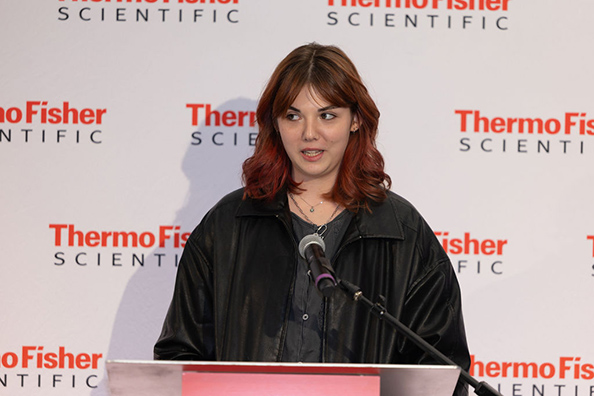 Emily Whitehead, now 20, the first child to receive CAR-T cell therapy in 2012, congratulated Thermo Fisher colleagues for their lifesaving work at the opening of the company’s Philadelphia Advanced Therapies Collaboration Center on Monday.
Created as a hub to help pharmaceutical and biotechnology companies, as well as academic collaborators, Philadelphia ATxCC will give those developing the next generation of these therapies access to the expertise and technology needed to automate and standardize their production.
Located within BioLabs for Advanced Therapeutics Philadelphia, a newly expanded 53,000-square-foot biotech incubator, the new center joins a network of similar facilities that Waltham, Massachusetts-based Thermo Fisher, a global life science company, operates in Carlsbad, California; Singapore; and South Korea.
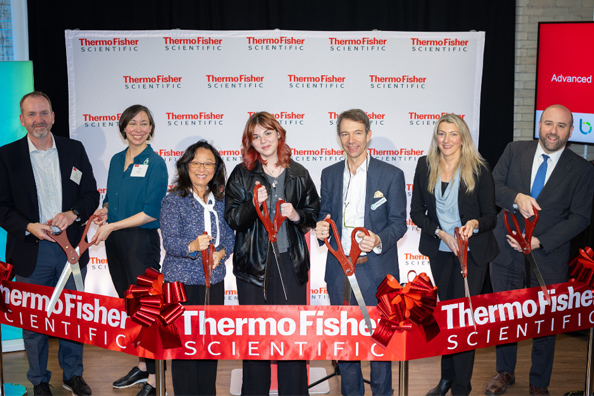 Thermo Fisher Scientific celebrates the opening on Monday of the company’s Advanced Therapies Collaboration Center in Philadelphia.
“Our new Advanced Therapies Collaboration Center in Philadelphia is designed to help innovators overcome critical hurdles in developing cell and gene therapies,” said Nicole Brockway, president of Thermo Fisher’s biosciences business. “This center will play a key role in supporting customers as they progress from the lab to the clinic and, most importantly, bring transformative therapies to patients faster.”
Cell and gene therapies use a patient’s own cells that are reprogrammed into supercharged fighting units to stop disease progression. Though these therapies have been in development since the 1970s, the most significant advances have occurred in the last two decades, including the FDA’s first gene therapy approval in 2017. Since then, the FDA has approved approximately 45 cell and gene therapies. More than 4,000 more therapies are currently in clinical trials, fueling hopes of a future treatment boom.
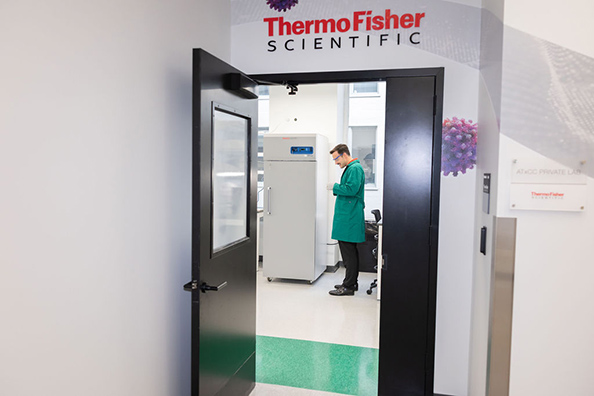 Thermo Fisher’s Philadelphia ATxCC, located within BioLabs’ 53,000-square-foot incubator, is the fourth such center in the company’s global network.
Overcoming the rigorous demands of a clinical trial is not the only hurdle to ensuring patients gain access to these new therapies. Drug developers must also determine how to transform these more personalized therapies - which require cell extraction, reprogramming, amplification and re-infusion - into something closer to an off-the-shelf product.
Through ATxCC, collaborators can leverage Thermo Fisher’s product and technology portfolio to create comprehensive, end-to-end manufacturing workflows that empower the scale of production needed for clinical and commercial production, Brockway said.
Thermo Fisher’s Dynabeads technology, for instance, was essential to the T-cell therapy that Emilly received in 2012. The Dynabeads isolate, activate and expand the immune system’s T-cells that have been reprogrammed to recognize and fight cancer cells in each individual patient. The cells are then reintroduced into the patient to find and kill cancerous cells. Pioneered in the 1980s, the magnetic Dynabeads are used today in countless scientific applications, cited in tens of thousands of published articles and used in more than 50,000 diagnostic instruments.
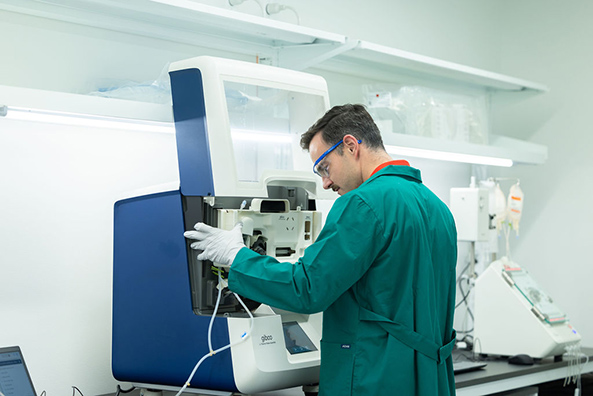 Philadelphia ATxCC will give those developing the next generation of cell and gene therapies access to Thermo Fisher’s expertise and technology needed to automate and standardize production
The collaboration centers also provide dedicated regulatory, quality and partnership management teams to help developers advance their cell therapy programs by addressing new challenges and enabling platform-specific support, Nicole said.
Dozens of Thermo Fisher collaborators and company leaders from several businesses joined the celebratory ribbon-cutting ceremony and toured the new facility, including Rick Siger, secretary of Pennsylvania’s Department of Community and Economic Development.
“Major players like Thermo Fisher and Biolabs collaborating on a project like this is a big win for our life sciences ecosystem,” Rick said during the ribbon-cutting ceremony.
Johannes Fruehauf, Ph.D., M.D., founder and CEO of BioLabs said the facility’s collaboration with Thermo Fisher creates an important and unique resource for teams working on groundbreaking therapies in the city.
“It will offer game-changing access to high-end technologies not only for our BioLabs members but also to external high-potential biotechs from across the East Coast and internationally,” he said.