
-
Our Mission
Everything we do starts with our Mission: to enable our customers to make the world healthier, cleaner and safer.
Read More -
Our Mission
Everything we do starts with our Mission: to enable our customers to make the world healthier, cleaner and safer.
Read More -
Our Mission
Everything we do starts with our Mission: to enable our customers to make the world healthier, cleaner and safer.
Read More-
- Tackling Crime by Trading Punishment for Treatment
- Customer Stories
- Removing the word serial with rapid DNA
- Turning the tap on without fear
- Second shot at life
- Mission in a Minute
- Creating Empowerment Opportunities in the Veterinary Sciences
- Building hope and affordable homes in Michigan
- Preeclampsia
- This Girl is On Fire
- Counting on You
- Allergy Diagnostic Tests Help Ambitious Tennis Player Get Back in the Game
- Tackling Crime by Trading Punishment for Treatment
- POWER Act Aims to Fund Science-based Technology to Address Opioid Crisis
- Supporting connections that lead to life-saving medical care
- Microbiologist's near-fatal battle with sepsis highlights urgent need for awareness and better treatment protocols
- An Icelandic volcano expedition exploring newly formed lava tubes uncovers insights into Earth's origins.
- How Thermo Fisher Scientific colleagues partner with Ronald McDonald House to support families of pediatric patients
- This is a test
- This is another test for a tutorial!
- Text and Image Demo
- Survivor of domestic violence finds new hope with prosthetic hand
- Thermo Fisher colleagues’ passion to advance HIV clinical trials help make lifesaving therapies a reality
- Clean the World and Thermo Fisher volunteers support communities hard hit by natural disaster
- Thermo Fisher volunteers assemble birthing kits to support underserved mothers and babies
- Life-saving allergy treatment
- Water wise
- Better texture for better batteries
- Lab automation goes viral in honeybee disease research
- How NIH funding transforms organ transplantation
- Thermo Fisher Scientific launches state-of-the-art Advanced Therapies Collaboration Center
- Discovery opens doors for cheaper and quicker battery manufacturing
- Tufts Center study shows integrated drug development services could speed delivery of new therapies to patients up to 3 years faster
- This is a new test
- Thermo Fisher opens the Centre for Advanced Training and Innovative Research to build the next generation of scientists in South Africa
- Thermo Fisher collaboration with Project HOPE helps create opportunities for Nigerian youth
- Thermo Fisher and Rise Against Hunger provide lifesaving support in Haiti
- New Thermo Fisher manufacturing facility boosts U.S. supply chain resilience and creates jobs
- Science and genetic testing buy Stage 4 lung cancer patient 10 more years, and counting
- Thermo Fisher and OpenAI collaboration aims to accelerate clinical trials and enable the delivery of new medicines to patients sooner.
- FDA Clears Thermo Fisher’s EXENT to aid in confirming the diagnosis of multiple myeloma.
- Thermo Fisher Scientific Opens Its Fourth State-of-the-Art Cell and Gene Therapy Collaboration Center
- Turning incurable cancer into a manageable disease: Hope rises for multiple myeloma patients
- Thermo Fisher’s “Her Science” program helps build a community for emerging women scientists
- Tackling Crime by Trading Punishment for Treatment
- How CAR-T cell therapy gave Gideon his tomorrow
- Thermo Fisher’s growing AI ecosystem aims to transform how science is done
- Rethinking Drug Development: How science is taking a more human-relevant approach with support from Thermo Fisher Scientific
-
-
Our Mission
Everything we do starts with our Mission: to enable our customers to make the world healthier, cleaner and safer.
Read More

By Terri Somers,
Senior Manager, Global PR and StoryLab
As companies in virtually every global business sector contemplate how to integrate AI to drive efficiencies and innovation in an increasingly complex, data-rich world, Thermo Fisher Scientific’s recent announcements of several AI-related collaborations show how a global life sciences company is making it happen.
Thermo Fisher announced during the recent 44th annual J.P. Morgan Healthcare Conference that it would collaborate with NVIDIA, which builds the engines that power modern computing and AI. Meanwhile, TetraScience, which organizes and prepares scientific data across disparate equipment and vendors so that AI can decipher and use it, announced at the conference that it, too, would collaborate with Thermo Fisher.
It was the fourth AI-related collaboration for Thermo Fisher announced in as many months. The push comes as life sciences labs generate unprecedented volumes of data, straining traditional, manual research methods.
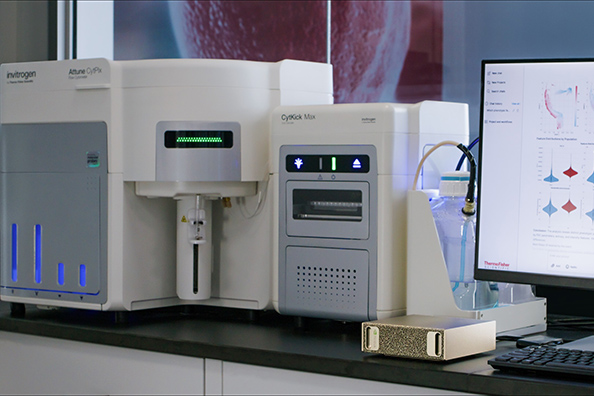 Invitrogen Attune CytPix Flow Cytometer
“Artificial intelligence coupled with laboratory automation will transform how scientific work is performed,” said Gianluca Pettiti, executive vice president at Thermo Fisher, a global provider of scientific instruments, reagents and services. “By combining Thermo Fisher’s leadership in laboratory technologies with NVIDIA’s digital and AI solutions, we can help customers work faster, improve accuracy and get more value out of each experiment, ultimately accelerating discoveries that can have significant human impact.”
The company’s vision is to equip laboratories with next-generation tools and technology that can be seamlessly integrated, helping to democratize access to enhanced capabilities and enable smarter, connected laboratory environments. The current reality is that in most laboratories, scientists still perform many tasks manually, from designing experiments and setting up instrumentation to preparing samples, running instruments and interpreting results.
Each of Thermo Fisher’s new AI-related collaborators provides distinct but complementary technology to help fulfill its vision. Together, the collaborations extend across the full scientific workflow, from experimental design and data generation to analysis and decision-making.
In that ecosystem, NVIDIA delivers the high-performance computing foundation needed to run advanced AI models directly on scientific data generated by Thermo Fisher instruments. NVIDIA’s accelerated computing and AI infrastructure will be integrated into Thermo Fisher’s scientific instrumentation and laboratory software.
On Oct. 16, Thermo Fisher announced that it would collaborate with San Francisco-based OpenAI, which enables natural-language interaction with data and systems, to accelerate scientific innovation, enhance productivity and reduce complexity. The company said OpenAI is initially being embedded to advance the use of AI in its clinical research and drug development workflows, enabling customers to get medicines to patients faster and more cost-effectively.
Cambridge, Mass.-based TetraScience’s cloud-based technology will harmonize data generated by diverse technologies, standardizing it so it can be understood and analyzed by AI.
In a Sept. 30 announcement, BenchSci, a Toronto-based company that uses published scientific studies to help scientists choose the right lab tools and experiments to advance their research, said it would also collaborate with Thermo Fisher.
One example of how AI could be applied is in instruments such as Invitrogen Attune CytPix Flow Cytometer, which scientists use to image, visualize and analyze cells in critical applications like cell therapy, oncology and immunology. Coupled with AI technologies, the instrument could help interpret research objectives, guide data analysis, highlight meaningful patterns, and offer recommendations.
“We are entering the era of ‘lab-in-the-loop’ science, where the trinity of AI, agents and instruments will be able to scale scientific discovery at industrial pace,” said Kimberly Powell, vice president of healthcare at NVIDIA, based in Santa Clara, Calif. “Working with Thermo Fisher, we are building the fundamental infrastructure of autonomous labs, creating a powerful research and discovery flywheel accelerating the pace of life sciences breakthroughs.”
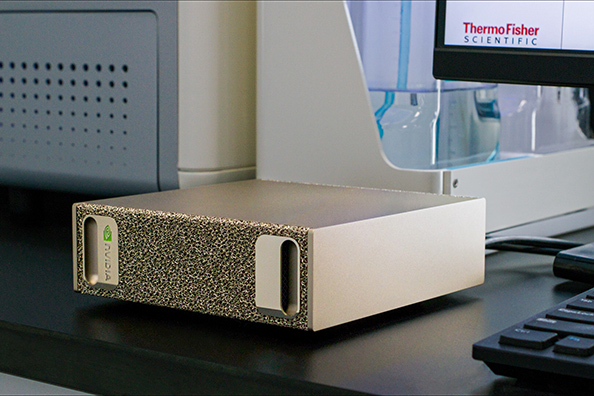 NVIDIA's DGX Spark