
404
The page you requested could not be found.
The page you requested could not be found.
Search
April 2023 | Nikki Bornhorst
For those diagnosed with an allergy to sesame, recent changes in federal legislation might seem like a light at the end a long and confusing food allergies tunnel.
The Food Allergy Safety, Treatment, Education, and Research (FASTER) Act was signed into law in 2021 and went into effect on Jan 1, 2023. Among other things, it means that sesame has been added to the list of major food allergens and now must be included on food labels.

At face value, these look like positive changes for those with sesame allergies, but a deeper dive shows some unexpected complications.
For example, foods you've been eating safely might now have sesame added to them, as well as listed as an ingredient on the label. Does that mean eating your favorite food product now will cause an allergic reaction? Quite possibly.
It can be costly for food manufacturers to keep sesame away from other foods and equipment – and to prove that they're doing so. Sometimes it is easier just to add sesame to their products (and labels).
OK. We know you are likely feeling lost at this point. What is safe for you (or your family) to eat?
You are in the right place. Allergy Insider is here to help you sort through the confusion. We're your ally in all things allergy.
The first step is determining if you have a sesame allergy. A specific IgE allergen component test can help aid in accurate diagnosis.
Ruling in or ruling out a sesame allergy and determining your sensitization and severity are key to moving forward.
And if you have been previously diagnosed with an allergy to sesame, it might be time for a retest. More on that later.
If a sesame allergy has been determined by your healthcare provider, in conjunction with allergy testing, then understanding how to accurately read food labels is an important next step.
We can't change the way companies label products, but we can offer up some guidance on better understanding what those labels say.
For example, sesame seed and sesame oil can be processed in many different ways and may be labeled under a different name, such as:1
Side note: sesame can be found in more than just food products. It also may be in cosmetics, lotions, and pharmaceutical items.1
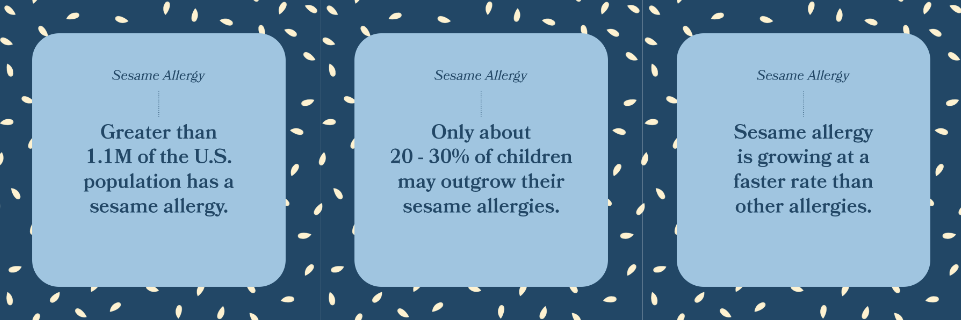
More than 1 million people in the United States have a sesame allergy.2 And this allergy is growing at a faster rate in the U.S. than other food allergies.3
With only about 20-30% of children outgrowing their sesame allergy, it can be a lifelong battle for many.4
Not only is it becoming a more common allergy, but it also has the potential for severe allergic reactions. Among common seeds, peanut, and tree nuts, sesame was found to cause allergic symptoms with the highest severity.5
Based on a physical exam and symptom history (including a history of allergic reactions), your healthcare provider may recommend testing that includes an allergen component test, which may help reveal which proteins you are sensitized to.
For sesame specifically, a Ses i 1 allergen component test may help identify if you are susceptible to a severe reaction and provides your healthcare provider with more detailed information than a skin prick test or whole allergen blood test.6,7
And that's crucial.
Knowing the proteins, or components, within each allergen that may be triggering your symptoms can help guide your management plan.
If you've previously been told that you have a sesame allergy, it might be appropriate to talk to your healthcare provider and discuss if a sesame component test is now appropriate.
Component testing is not a new technology, but the test for sesame components is a new, FDA-cleared test.
A previous sesame allergy diagnosis would likely have been based on a whole allergen test, which might not have provided the clearest picture.
Why?
A whole allergen test gives you the big picture. It may help determine that you have a sensitization to sesame, but that's about as far as it goes. An allergen component test gets into the details, including your risk for severe reaction.8
Check out this article that details the differences between whole allergen tests and allergen component tests.
So, it may be worth a conversation with your healthcare provider to see if an allergen component test is needed to help rule in or rule out a sesame allergy.
Another reason an allergy component test might be warranted is because it can help determine cross-reactivity.8
Allergy cross-reactivity occurs when the body's immune system identifies the proteins in one substance (e.g., pollen) and the proteins in another (e.g., a fruit or vegetable) as being similar.
The potential for cross-reactivity can make diagnosing specific allergies somewhat complicated.
Sesame cross reacts with peanuts, tree nuts, and other seeds, so it can be difficult to understand what you are truly allergic to without an oral food challenge (when you eat small amounts of foods you suspect you are allergic to, under the supervision of your healthcare provider).5
Allergen component tests like the sesame Ses i 1 can help clinicians discuss with patients, the risks involved and appropriateness for oral food challenges.
For example, you might have a sensitization to the overall category of seeds and tree nuts after a whole allergen test. But after an allergen component test and oral food challenge, it's determined that you have a high risk for severe reaction to walnuts (a tree nut) and just a minor sensitization to sesame (a seed).
And that's crucial information to have. In that case, you wouldn't need to remove sesame from your diet. Bring on the tahini!
Talk with your healthcare provider about getting a component test. And keep in mind you don't have to go to a specialist; your primary care provider can order the test.
Test results should be interpreted by your healthcare provider in the context of your clinical history. They will determine a final diagnosis and help you with a management plan.
Allergy Insider is a resource to learn about all things allergy and testing options. We are here to help you on this journey. We’ve also partnered with our friends at Zestfull, to create A Guide to Understanding and Living with a Sesame Allergy, shedding light on important facts, tips, and empowerment while managing a sesame allergy.
Your healthcare provider is also a key resource who can offer guidance on a management plan to ensure you can make choices that won't put you at unnecessary risk.
Before you go, we'd appreciate your feedback to help us better understand your needs and improve our services.


Create a summary of your allergy symptoms in a downloadable document

Share the summary with your healthcare provider for a productive conversation about allergy blood testing

Gain an optimized diagnosis and a personalized treatment plan

Allergies affect us all differently. This questionnaire will summarize your specific allergy symptoms to share with your healthcare provider and learn more about your testing options.
|
Create a summary of your allergy symptoms in a downloadable document |
Create a summary of your allergy symptoms in a downloadable document
|
Share the summary with your healthcare provider for a productive conversation about allergy blood testing |
Share the summary with your healthcare provider for a productive conversation about allergy blood testing
|
Gain an optimized diagnosis and a personalized treatment plan |
Gain an optimized diagnosis and a personalized treatment plan

Purchase the same tests your doctor orders and get insights into your health. Our convenient allergy tests can measure your immune response to common allergies found in the air, in foods and with pets.

Buy your own allergy tests online, anytime. Test for 15 common food allergens and up to 25 common indoor and outdoor respiratory allergens. The same quality lab tests doctors use and recommend, but no doctor visit required for purchase.

Get quality care on your schedule. Our board-certified providers can perform an exam, evaluate your symptoms, and test you for allergies to create a personalized treatment plan.
You are now leaving thermofisher.com and going to a site owned and operated by an independent third party. Thermo Fisher Scientific is not responsible or liable for any content or services of any independent third-party site. Thermo Fisher Scientific does not represent independent third parties or the customer if the two enter into a transaction. Privacy and security policies on these sites may differ from those practiced by thermofisher.com. We encourage you to review the policies and terms of all websites you may choose to visit.

You are now leaving thermofisher.com, and going to ondemand.labcorp.com, owned and operated by an independent third party. Thermo Fisher Scientific is not responsible or liable for any content or services of ondemand.labcorp.com. Thermo Fisher Scientific does not represent either Labcorp OnDemand or the customer if the two enter into a transaction. Privacy and security policies of ondemand.labcorp.com may differ from those practiced by thermofisher.com. We encourage you to review the policies and terms of all websites you may choose to visit.
WE’RE HERE TO HELP
Get science-backed answers to your allergy questions. Test your body’s immune response to indoor and outdoor allergens like dust and pollen, dog and cat dander and saliva, or to common food allergy triggers including lactose, shellfish and nuts.

VISIT QUESTHEALTH.COM
Get insights about your health, when you want them. Test for 15 common food allergens and up to 25 common indoor and outdoor respiratory allergens. You will have the option to discuss your results with an independent physician at no extra cost.
You are now leaving thermofisher.com and going to questdiagnostics.com owned and operated by an independent third party. Thermo Fisher Scientific is not responsible or liable for the content or services of questdiagnostics.com. Thermo Fisher Scientific does not represent either Quest Diagnostics or the customer if the two enter into a transaction. Privacy and security policies of questdiagnostics.com may differ from those practiced by thermofisher.com. We encourage you to review the policies and terms of all websites you may choose to visit.

MINUTECLINIC AT CVS
High quality and affordable health care is available on your schedule. Our board-certified providers can perform an exam, evaluate your symptoms, and test you for allergies to create a personalized treatment plan.
Appointments available in-person and virtually 7 days a week, including evenings
You are now leaving thermofisher.com, and going to cvs.com/minuteclinic, owned and operated by an independent third party. Thermo Fisher Scientific is not responsible or liable for the content or services of cvs.com/minuteclinic. Thermo Fisher Scientific does not represent either MinuteClinic at CVS or the customer if the two enter into a transaction. Privacy and security policies of cvs.com/minuteclinic may differ from those practiced by thermofisher.com. We encourage you to review the policies and terms of all websites you may choose to visit.


