
404
The page you requested could not be found.
The page you requested could not be found.
Search
May 2026 | ✓ Medically Reviewed by: Gary Falcetano, PA-C, AE-C
If it seems like more and more kids have allergies these days, that impression isn’t necessarily wrong. Clinicians are finding evidence for an increase in allergies, and they’re continuously exploring the connections between multiple types of childhood allergies.1 What begins as eczema (technically called atopic dermatitis) in infancy can progress to food and respiratory allergies later on, a phenomenon called the “atopic march” or “allergic march.”2

These conditions are difficult for kids and parents alike because they can affect quality of life. By working with your healthcare provider, you can interrupt or delay this march and gain better control over your child’s allergic triggers. Those triggers can change over time, and not every child experiences every stage of the allergic march, which makes testing and evaluations with your provider even more important to understand and address the allergic march. Here’s what you need to know:
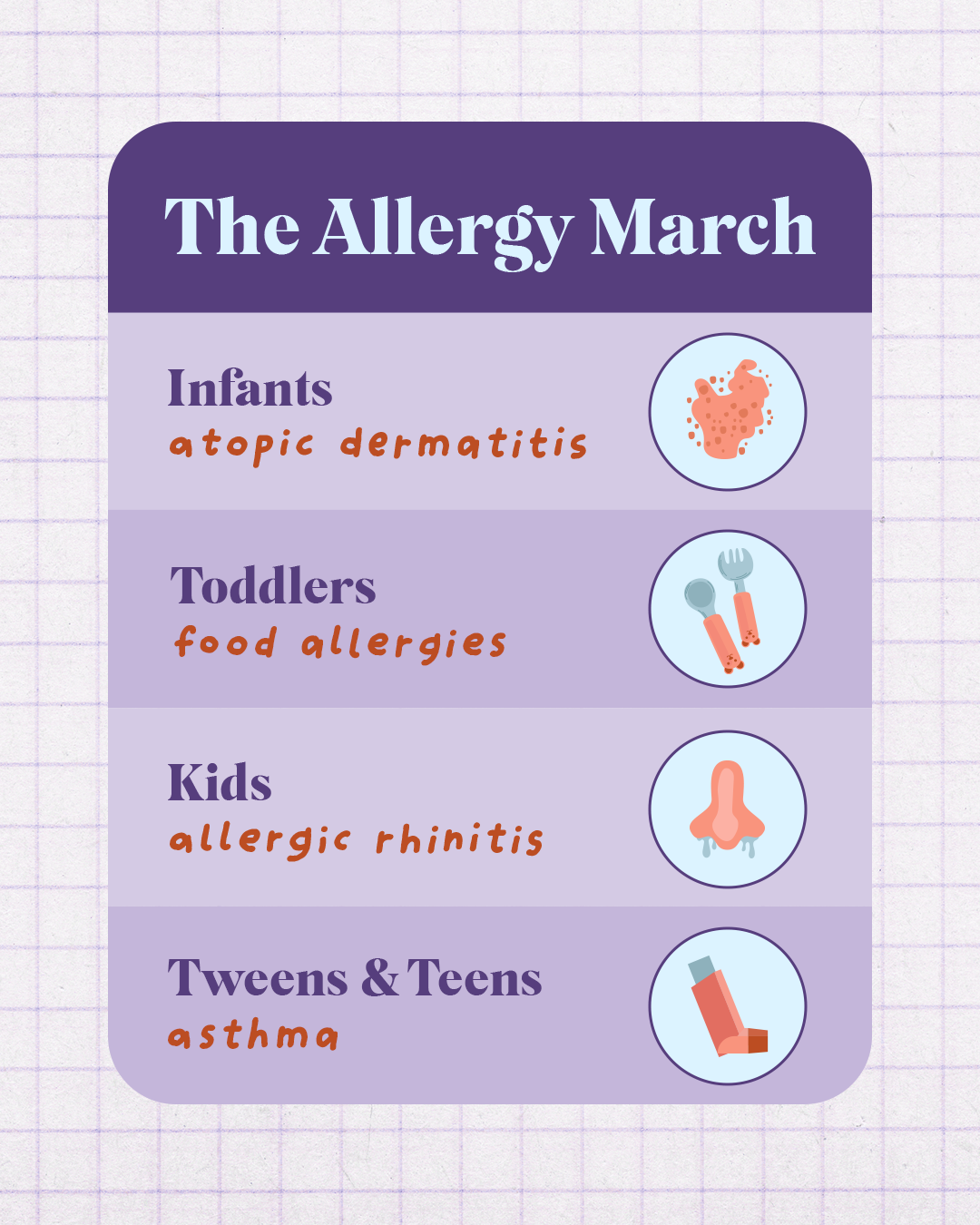
The atopic march (or allergic march) is a progression of allergic conditions in infants and children. Typically, this begins with atopic dermatitis early in life and proceeds to food allergies, then allergic rhinitis and asthma by the time kids reach their tween and teenage years. In terms of the bodily systems affected, it goes from skin to the gastrointestinal tract to the respiratory tract.3
Allergies stem from genetic and environmental factors, making it complicated to pinpoint one particular cause of the atopic march. However, according to recent studies, damage to the skin can drive allergen sensitization that affects the skin and then moves into the digestive and respiratory systems. Changes to babies’ microbiome may also play a role.3
While there may not be one certain cause, the atopic march does have consistent characteristics at various stages of childhood.
It’s important to remember that not every child with atopic dermatitis will go on to develop every stage of the allergic march, and not every child with asthma has had eczema in the past.4 But, this progression does have a common pattern that parents should be aware of.
The allergic march starts with atopic dermatitis in very young children, most often in the first 12 months of life. Studies have found that 45% of babies with atopic dermatitis were less than 6 months old, and 85% had the condition before age 5.3
Having eczema is connected to the risk of developing food allergies early in life. One study estimated that children with atopic dermatitis were six times more likely to develop a food allergy than kids without it.4 Sensitivity to milk, peanuts, soy, or eggs is common, with allergy diagnosis for milk, eggs, and soy happening mostly between 0-3 years old, and peanut allergies most common for children aged 3-5 years.3 Both eczema and food sensitization are strong predictors of the later stages of the atopic march, allergic rhinitis and asthma.4
Allergic rhinitis is often called hay fever, despite the fact that it isn’t triggered by hay and it rarely involves a fever. It’s triggered by sensitivity to pollen, mold, pet dander, or bugs such as dust mites or cockroaches (or more accurately, their droppings). Symptoms include a stuffy or runny nose, itchy or watery eyes, congestion, and headaches.5
Numerous studies have shown a link between atopic dermatitis and allergic rhinitis. One particular study found that 62% of kids diagnosed with atopic dermatitis were also diagnosed with allergic rhinitis. And allergic rhinitis is closely connected to asthma: in studies, up to 81% of asthma patients also reported suffering from allergic rhinitis.3
Eczema and food allergies in early childhood show strong correlations with developing asthma later in childhood. The more severe an atopic dermatitis case is, the more likely a child is to develop asthma. The presence of eczema early in life can also mean more severe asthma and greater persistence of this condition into adulthood.4
Studies found that food allergies matter too. 35% of kids with a food allergy developed asthma later on, and those with multiple food allergies were at an even higher risk. These findings were similar for the development of allergic rhinitis, all of which shows that our airways are connected and as a result, these conditions are too.6
The many manifestations of the atopic march can be frustrating for kids suffering from symptoms and for parents unsure of why those symptoms are happening. This is why diagnostic testing for allergies is critical. Simply put, you can’t effectively address a problem if you don’t know what’s causing it. Here are some tips.
Your child’s healthcare provider can order a specific IgE blood test. The test requires just a single blood draw and can be done regardless of age (including infants), skin condition, or antihistamine use.7 For infants and young children, a single needle prick for a blood sample may be less traumatic than the repeated scratching of a skin-prick test.
The results from specific IgE tests can help rule in or rule out allergies. Once you know any allergic triggers your child may have, you can avoid those triggers and work on a management plan. And that can help interrupt or delay the atopic march.3
Based on your child's allergy symptoms and their medical history, your healthcare provider might find it appropriate to order a specific IgE blood test with allergen components. For food-related allergies, testing with allergen components means finding out which proteins within a whole allergen that your child is sensitized to. You can think of an egg as a whole allergen and the various proteins that make up that egg as the allergen components.
Why does it matter which protein your child might be reacting to? Well, if we're keeping with the egg theme, there are some proteins within it that are impacted by high temperatures. That means for some children, they might be able to tolerate an egg that was heated at a high temperature – like in a birthday cake.8 Having a clearer picture of your child's allergies can help alter the rhythm of the allergic march and minimize the impact to their quality of life.
An accurate diagnosis can result in more effective and targeted treatments. For example, knowing which specific allergens are causing symptoms can help your child minimize exposure to those allergens. That can include everything from avoiding certain types of foods to minimizing exposure to pet dander or dust mites in your home. And minimizing exposure might help reduce symptoms.
Getting to the bottom of what's causing symptoms and identifying all allergic triggers also is important because it can help define appropriate treatments. That can include everything from over-the-counter antihistamines to targeted treatments, like allergen immunotherapy (allergy shots).
If your child seems to be on the allergic march path, it might be time to talk with your healthcare provider about a specific IgE blood test. You might not be able to completely halt this progression of allergies, but you may be able to minimize symptoms and the severity of the impact to their quality of life.
Learn more about how to get an allergy blood test.
Before you go, we'd appreciate your feedback to help us better understand your needs and improve our services.


Create a summary of your allergy symptoms in a downloadable document

Share the summary with your healthcare provider for a productive conversation about allergy blood testing

Gain an optimized diagnosis and a personalized treatment plan

Allergies affect us all differently. This questionnaire will summarize your specific allergy symptoms to share with your healthcare provider and learn more about your testing options.
|
Create a summary of your allergy symptoms in a downloadable document |
Create a summary of your allergy symptoms in a downloadable document
|
Share the summary with your healthcare provider for a productive conversation about allergy blood testing |
Share the summary with your healthcare provider for a productive conversation about allergy blood testing
|
Gain an optimized diagnosis and a personalized treatment plan |
Gain an optimized diagnosis and a personalized treatment plan

Purchase the same tests your doctor orders and get insights into your health. Our convenient allergy tests can measure your immune response to common allergies found in the air, in foods and with pets.

Buy your own allergy tests online, anytime. Test for 15 common food allergens and up to 25 common indoor and outdoor respiratory allergens. The same quality lab tests doctors use and recommend, but no doctor visit required for purchase.

Get quality care on your schedule. Our board-certified providers can perform an exam, evaluate your symptoms, and test you for allergies to create a personalized treatment plan.
You are now leaving thermofisher.com and going to a site owned and operated by an independent third party. Thermo Fisher Scientific is not responsible or liable for any content or services of any independent third-party site. Thermo Fisher Scientific does not represent independent third parties or the customer if the two enter into a transaction. Privacy and security policies on these sites may differ from those practiced by thermofisher.com. We encourage you to review the policies and terms of all websites you may choose to visit.

You are now leaving thermofisher.com, and going to ondemand.labcorp.com, owned and operated by an independent third party. Thermo Fisher Scientific is not responsible or liable for any content or services of ondemand.labcorp.com. Thermo Fisher Scientific does not represent either Labcorp OnDemand or the customer if the two enter into a transaction. Privacy and security policies of ondemand.labcorp.com may differ from those practiced by thermofisher.com. We encourage you to review the policies and terms of all websites you may choose to visit.
WE’RE HERE TO HELP
Get science-backed answers to your allergy questions. Test your body’s immune response to indoor and outdoor allergens like dust and pollen, dog and cat dander and saliva, or to common food allergy triggers including lactose, shellfish and nuts.

VISIT QUESTHEALTH.COM
Get insights about your health, when you want them. Test for 15 common food allergens and up to 25 common indoor and outdoor respiratory allergens. You will have the option to discuss your results with an independent physician at no extra cost.
You are now leaving thermofisher.com and going to questdiagnostics.com owned and operated by an independent third party. Thermo Fisher Scientific is not responsible or liable for the content or services of questdiagnostics.com. Thermo Fisher Scientific does not represent either Quest Diagnostics or the customer if the two enter into a transaction. Privacy and security policies of questdiagnostics.com may differ from those practiced by thermofisher.com. We encourage you to review the policies and terms of all websites you may choose to visit.

MINUTECLINIC AT CVS
High quality and affordable health care is available on your schedule. Our board-certified providers can perform an exam, evaluate your symptoms, and test you for allergies to create a personalized treatment plan.
Appointments available in-person and virtually 7 days a week, including evenings
You are now leaving thermofisher.com, and going to cvs.com/minuteclinic, owned and operated by an independent third party. Thermo Fisher Scientific is not responsible or liable for the content or services of cvs.com/minuteclinic. Thermo Fisher Scientific does not represent either MinuteClinic at CVS or the customer if the two enter into a transaction. Privacy and security policies of cvs.com/minuteclinic may differ from those practiced by thermofisher.com. We encourage you to review the policies and terms of all websites you may choose to visit.


